
Scam Situation in Hong Kong
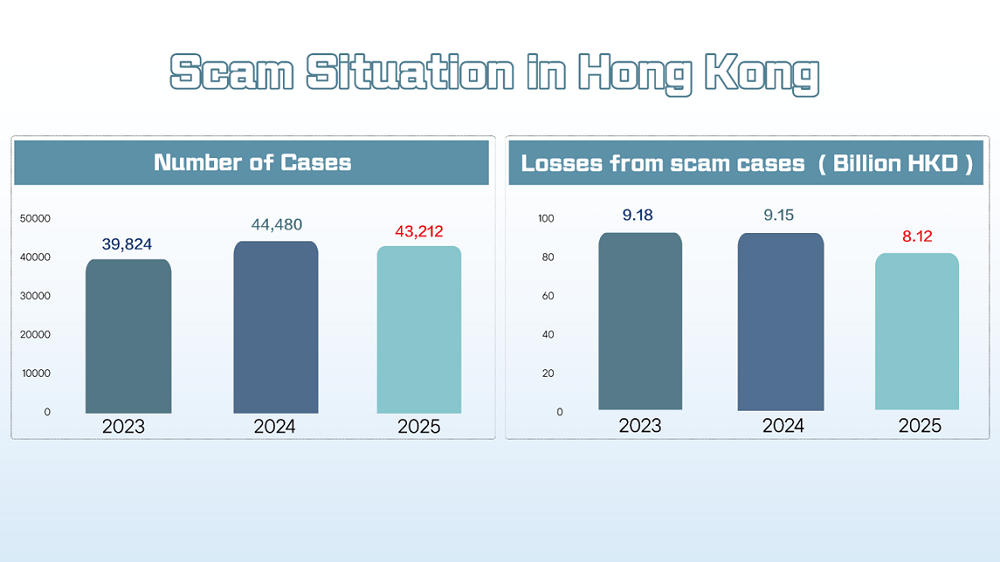
Over the past few years, Police have stepped up efforts to combat deception. Although the number of cases remained high in 2025, totalling 43 212 cases, the figure represented a slight decrease of 2.9% (-1 268 cases) compared with 2024. This marked the first decline, following consecutive annual rises in deception figures since 2019. Monetary losses also decreased, dropping from approximately $9.2 billion to about $8.1 billion, a decline of 11.3% (-$1.03 billion).
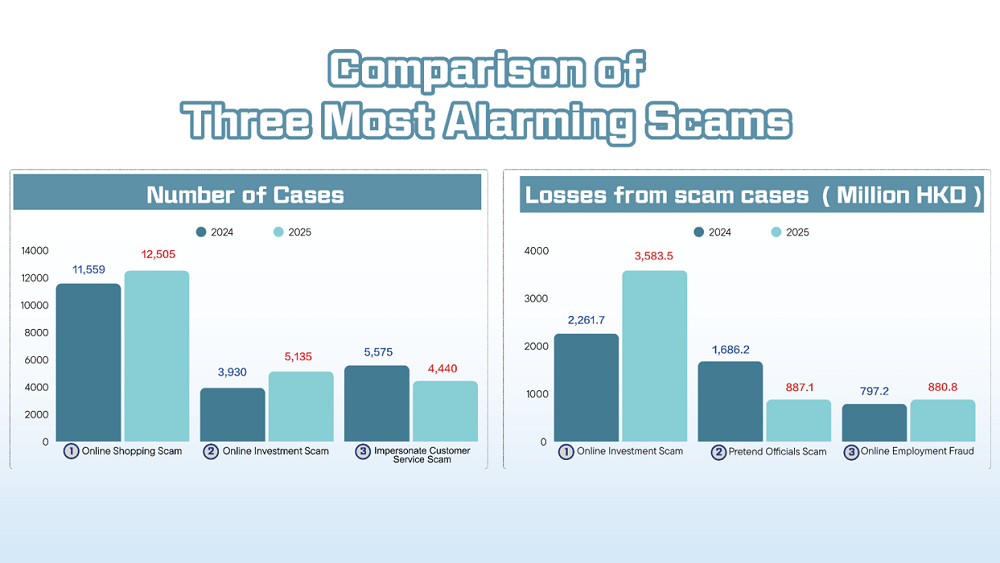
Deception cases accounted for nearly half of all reported crimes (48.5%). Among the various categories, e-shopping fraud (12 505 cases, +946 cases, +8.2%) was the most prevalent, accounting for 28.9% of all deception cases. Police noted that e-shopping fraud related to concert tickets increased significantly following the opening of the Kai Tak Sports Park in March 2025. A total of 2 805 cases were recorded last year, representing a year-on-year increase of 61.8% (+1 071 cases).
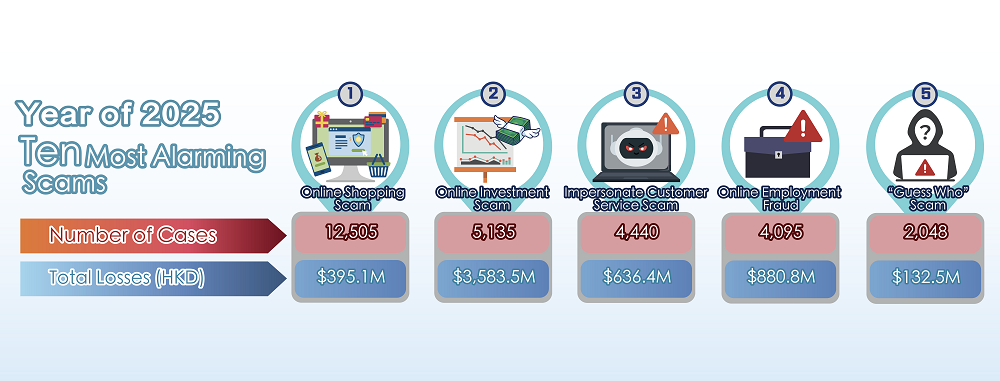
Online investment fraud accounted for the highest monetary loss, with 5 135 cases recorded, registering an increase of 30.7% (+1 205 cases). The total loss amount involved reached $3.58 billion, representing a rise of 58.4% (+$1.32 billion). While accounting for 11.9% of all deception cases, online investment fraud constituted 44.1% of the total monetary loss, with the average loss per case rising from about $580,000 in 2024 to about $700,000 in 2025.
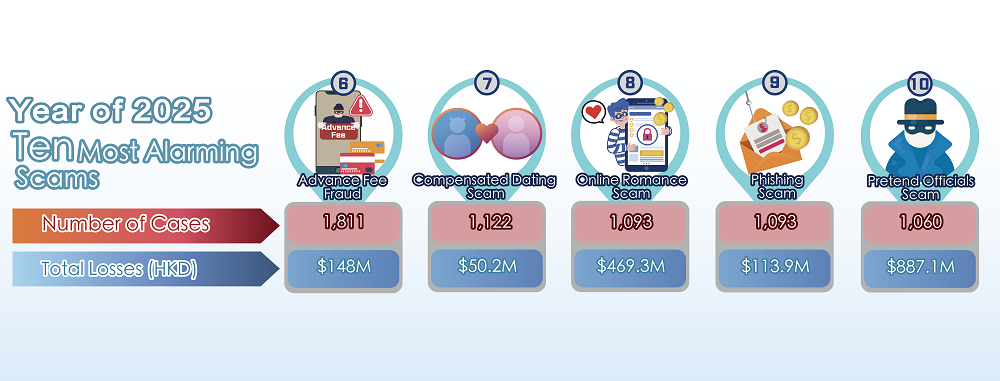
There were 4 095 cases of online employment fraud, an increase of 6.3% (+242 cases). Most of these were “click farming” scams (96.5%), in which fraudsters falsely claimed that commissions could be earned by making advance payments to boost sales figures. In contrast, telephone deception recorded 8 621 cases, a decrease of 6.3% (-583 cases). This decline included a 20.4% drop in telephone deception cases involving “impersonating customer service”, a tactic that first appeared in 2024, which accounted for 4 440 cases (-1 135 cases). Phishing scams and “compensated dating scams” recorded 1 093 cases (-1 638 cases) and 1 122 cases (-907 cases) respectively, registering a 60% and 44.7% drop.
Four major strategies
Fraudulent activities have become highly industrialised, characterised by a sophisticated division of labour and a cross-border nature. To combat these scams, both local measures and cross-border collaboration are indispensable. Accordingly, Police have formulated four major strategic directions.
Combating fraud industry chains
The first strategy focuses on dismantling fraud industry chains. The priority is to tackle the use of telecommunications networks for fraudulent purposes at the source. In June 2025, the Hong Kong Police Force conducted a joint operation with its Singaporean counterpart, arresting eight persons suspected of using 400 000 Hong Kong mobile SIM cards to generate massive volumes of scam calls. In response, the working group established by Police, the Office of the Communications Authority and the telecommunications sector has been actively studying and implementing various countermeasures. Notably, the Commerce and Economic Development Bureau will submit a legislative proposal in 2026, which includes lowering the registration limit for pre-paid SIM cards per user and introducing new offences targeting their improper use.
To tackle the downstream activities of fraud industry chains, Police are prioritising the crackdown on stooge accounts used to collect illicit proceeds. Apart from strengthening enforcement, expediting prosecutions and seeking enhanced sentencing, Police and the banking sector are actively exploring ways to prevent the opening of stooge accounts. With the new legislation allowing bank-to-bank information sharing on suspicious personal accounts coming into effect in late 2025, and the official launch of the upgraded version of the Police-bank information sharing platform, FINEST, on December 15, 2025, interbank information sharing has recorded a multi-fold increase. Participation is also set to expand from 10 to all 28 retail banks.
Furthermore, Police partnered with the banking sector to launch the “Upstream Scam Intervention” scheme in 2023. By analysing the transaction patterns of stooge accounts, officers proactively contacted potential victims to dissuade them from transferring further funds to fraudsters. In 2025, Police successfully intervened in 4 060 deception cases (+69.4%) and intercepted fraudulent payments totalling $480 million, representing a more than 1.5-fold increase (+158.4%) compared with 2024. The total monetary loss from deception cases in 2025 fell by $1.03 billion, with the successful interventions under this scheme accounting for nearly half of the decline.
In addition to combating stooge accounts, the Virtual Asset Intelligence Taskforce, mentioned in last year’s Policy Address, was established in October 2025. Chairing the taskforce, Police will strengthen intelligence exchange with the Customs and Excise Department, regulators, and industry partners to jointly combat virtual asset-related crimes. Key priorities include optimising the stop-payment mechanism to further clamp down on criminals using cryptocurrency to collect crime proceeds and launder money.
Targeted publicity
The second major direction is targeted publicity aimed at achieving precision in scam prevention. Last year, Police identified Mainland students and the elderly as key targets for publicity and allocated more resources to enhance the anti-scam awareness of these two high-risk groups.
The monetary loss incurred by Mainland students in telephone deception was 2.9 times higher than that of local students, averaging approximately $690,000 and $176,000 respectively. In response, Police carried out extensive publicity and educational work in 2025 to prevent Mainland students from falling victim to telephone deception. These efforts included conducting surveys, seminars, and arranging campus visits by the anti-scam icecream van, etc. Through these year-long efforts, Police noted an improvement in the situation regarding their involvement in telephone deception. The number of cases and the amount of loss decreased by 9.2% and 16.9% respectively.
However, it was also observed that the number of cases and the amount of loss involving Mainland students in investment fraud surged by 3.6 times (+362.5%) and 6.5 times (+649.6%) respectively. For the general public as a whole, the total loss from online investment fraud was the highest among all deception categories (accounting for 44.1%). Therefore, Police will adjust the key publicity focus in 2026 by shifting the priority from Mainland students to combatting investment fraud, with a view to deploying resources flexibly to maximise crime prevention effectiveness.
Separately, online investment fraud caused substantial losses, with one-third ($1.18 billion) involving virtual assets. Many victims incurred losses after downloading fake mobile applications created by fraudsters and depositing funds for investment. To counter this modus operandi, relevant prevention tips have been provided on “Scameter+”, and Police will continue to conduct targeted publicity.
Furthermore, in 80% (80.4%) of investment fraud cases, victims were contacted by fraudsters via individual mainstream social media platforms and instant messaging applications. Police will enhance communication with the relevant companies, expecting them not only to co-operate more effectively with police investigations by providing information and removing fraudulent accounts and posts, but also to be more proactive in identifying suspicious accounts and posts to expedite blocking.
Regarding the elderly, the number of victims has risen across various categories of deception. In particular, “Guess Who” telephone deception saw both the number of cases and the amount of loss surge by over 50% (+58.1% and +52.8% respectively). As many elderly victims were swindled out of their savings and pensions, Police will continue to prioritise the elderly in its publicity efforts, including organising a series of anti-deception activities and producing and broadcasting promotional videos.
Promoting greater use of “Scameter+”
Thirdly, Police will intensify the promotion of “Scameter+”. Although downloads reached 1.15 million by the end of 2025, the penetration rate still leaves room for improvement. Consequently, Police launched new features for “Scameter+” in October 2025, including automatic user database updates and expanded reporting categories covering SMS and instant messaging applications. New artificial intelligence technology was also introduced to analyse suspicious website links and webpage screenshots reported by the public to detect the impersonation of banks, couriers, investment platforms and others. Once confirmed as malicious, these websites are instantly added to the database to block access for all users.
Following the launch of these new features, public reports of suspicious phone numbers and websites surged by about 60% and about 50% respectively; the number of suspicious phone numbers and websites added to the database doubled; furthermore, “Scameter+” proactively identified and blocked 267 scam domains not yet reported by the public. Compared to the pre-upgrade period, the number of searches on “Scameter+” rose by 17.6%, while alerts issued by the app surged by 66.5%, exceeding 130 000 in December 2025 alone. Police also requested telecommunications operators to intercept suspicious calls and websites. This timely intervention prevented the public from accessing fraudulent messages and led to a significant drop in phishing scams (-60%).
International collaboration
Police are actively promoting and participating in international co-operation to combat cross-border fraud more effectively. To this end, Police established the Cross-border Anti-Scam Collaboration Platform, “FRONTIER+”, with various countries/regions at the end of 2024. Its first joint operation in 2025 resulted in over 1 800 arrests.
The platform now comprises 13 members. Police will continue inviting other countries/regions to join, with a view to enhancing effectiveness in intelligence exchange, interception of scam proceeds and joint enforcement actions. While attending the INTERPOL General Assembly in Morocco in late November 2025, the Commissioner of Police held in-depth discussions with representatives from various countries to explore ways to strengthen co-operation. As the 2026 General Assembly will be held in Hong Kong for the first time, Police will seize the opportunity to strengthen collaboration and exchanges with different countries and regions to jointly tackle cross-border crimes.