
Beware of Scams: University Phone Scams Jump 143% year-on-year; New Student Loses Over HK$8M to Prentend Officials
2026-10-14
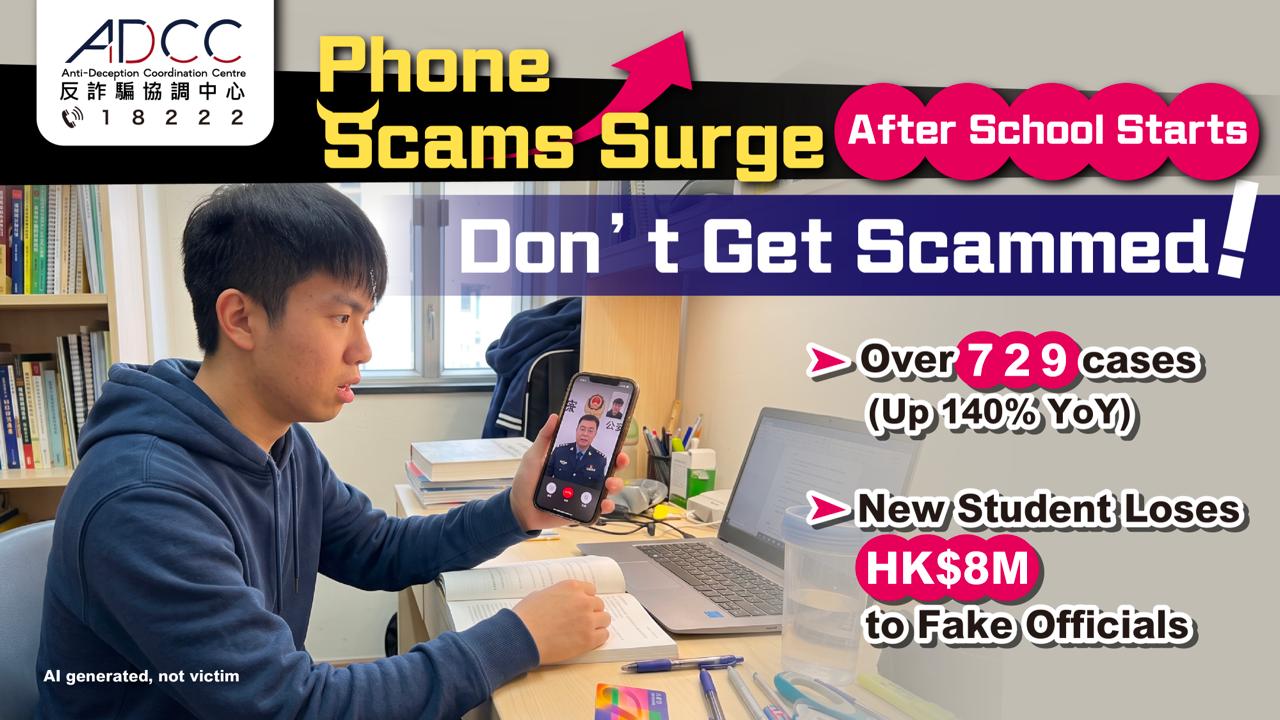
Since the start of the academic year, university students — particularly first-year students from the Mainland — have become prime targets of scammers, mainly involving pretend officials and impersonating customer service scams.
According to the latest figures:
1. Overall university scam situation: A total of 1,970 cases involving local and Mainland students were recorded, up 15% year-on-year. Total losses reached HK$230 million, an increase of 30%.2. Sharp rise in telephone deception: At least 729 cases were reported, a year-on-year surge of 143%, with losses rising by 60%. Of these, 428 involved impersonating customer service and 233 involved pretend officials.
3. Mainland students: 408 telephone deception cases were recorded (double last year’s figure), involving nearly HK$170 million (up 92% year-on-year). One Mainland freshman was defrauded of over HK$8 million in a single “Pretend Official” scam.
4. Local students: 321 telephone scam cases were recorded (up 86% year-on-year), involving HK$22 million (down 30% year-on-year).
Impersonating Customer Service
1. Impersonating customer service of banks, telecom operators, or online shopping platforms via call or text, claiming that there are account abnormalities, order issues, or available refunds2. Requesting to switch to WhatsApp or video call, or enable screen sharing
3. Under the pretext of “cancelling service / refund / identity verification”, scammers trick victims into entering a so-called “verification code” into the transfer amount field (thereby draining their savings)
4. Or targeting students’ commonly used e-wallets, falsely claiming the account needs to be unfrozen, and solicit verification codes or bank details
Pretend Officials
1. Impersonating the Immigration Department, Public Security, ICAC, etc., accurately stating the victim’s name, ID, or study details2. Accusing the victim of involvement in money laundering, contraband, or criminal cases, before transferring the call to fake police. Scammers then use video surveillance, take statements, and demand “bail / asset review” while enforcing absolute secrecy and forbidding contact with family or school
3. Instructing the victim to transfer money in batches to designated accounts, or handing over cash in person to someone claiming to be a “special agent”
Case 1
The victim, a first-year student newly enrolled at a university, received a call on 4 September from someone claiming to be from the Mainland Public Security Bureau. The caller alleged that the victim was involved in fraud and money laundering and asked him to “assist with the investigation.” The scammer then demanded multiple transfers under the pretext of “providing evidence of funds,” promising that the money would be returned after the investigation. Believing the claims, the victim transferred the money as instructed and lost over HK$8 million.
Case 2
The victim, a PhD student receiving a scholarship, received a call in August from someone claiming to be from the Immigration Department. Speaking fluent Cantonese, the caller said that someone had used the victim’s ID number to apply for a phone number in Shanghai and sent harassing messages to others, and instructed the victim to report the matter to the Shanghai police. The call was then transferred to another scammer, who asked the victim to download Teams, sign a confidentiality agreement with her boyfriend, and accept 24-hour surveillance. The scammer further instructed the victim to borrow money from her family under the pretext of “going to the US as an exchange student,” while monitoring her throughout via screen sharing. The victim ultimately lost HK$5 million.
Case 3
The victim, a second-year university student, received a call in July from someone claiming to be a Taobao staff member, stating that a free insurance policy previously gifted to her would now become chargeable. The victim said she had never applied for it and asked to cancel it. The scammer then transferred the call to an accomplice, who immediately instructed the victim to click a link, access a fake AI customer service platform to obtain a so-called “verification code,” and enter the code into the transfer amount field of her online banking app, resulting in a transfer of HK$200,000. The scammer later claimed there had been an operational error and asked the victim to enter the “code” again, leading to a second transfer of HK$200,000. The victim lost a total of HK$400,000.
Case 4
The victim, a first-year master’s student, received a phishing text message in October claiming that “the contract has expired and approximately HK$20,000 will be deducted.” Worried about being charged, the victim immediately called back the “cancellation” number provided in the message and, following the scammer’s instructions, logged into a fake UnionPay website to apply for cancellation. During the process, the scammer asked the victim to perform a transfer verification and promised that the transfer would not actually go through. Believing the claim, the victim transferred over HK$1.9 million and only realised she had been scammed after the money was successfully transferred.
Appeals
Remember: Mainland Public Security Bureau officers or law enforcement agencies will not call you in Hong Kong to handle cases. If the caller claims to be a “Mainland Public Security Bureau Officer”, hang up immediately.
Law enforcement officers will never ask you to pay a “guarantee fee” or provide bank details and financial passwords.
Even if strangers are able to tell your personal information, it does not mean they are genuine law enforcement officers. Scammers can obtain the personal information of the public by unlawful means.
Upon receiving a suspicious call, hang up immediately; do not call back the provided number, and do not click unknown links.
You may use “Scameter” on the CyberDefender website or the “Scameter+” app to check suspicious phone numbers, websites or receiving accounts.
If in doubt, immediately call the “Anti-Scam Helpline” 24-hour hotline 18222.