
Beware of Fake ICAC Officers! Students Studying Overseas Were Cheated and Flew to Hong Kong to Buy Gold Pellets and Hand Them to Scammers in Person, Losing up to $1.57 Million
2026-04-20
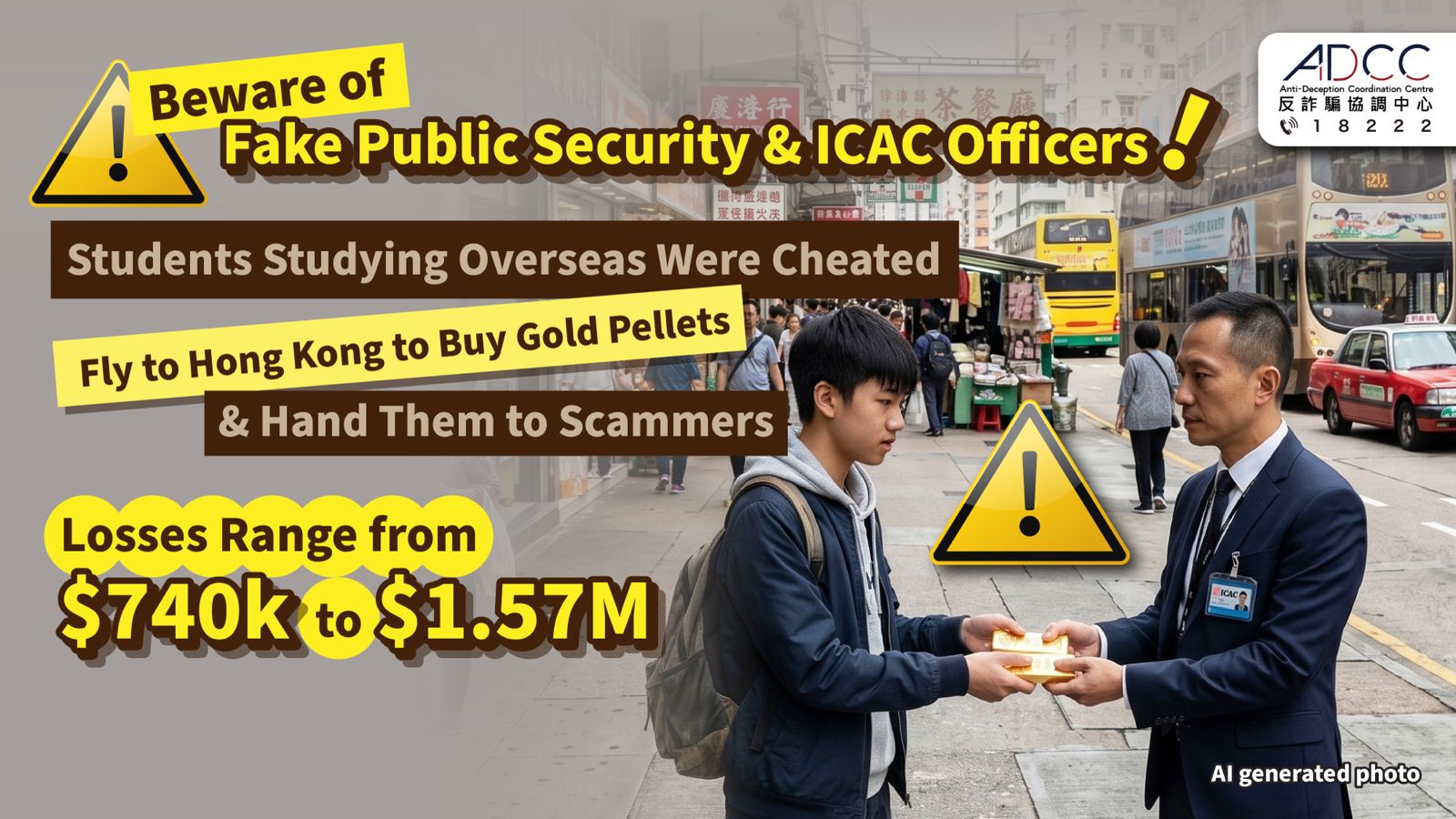
Recently, the Police received at least nine reports about “pretend officials” scams. Scammers who successively impersonated officers of the Shanghai Municipal Public Security Bureau and Hong Kong’s Independent Commission Against Corruption (ICAC) contacted students studying overseas. They lured those students to travel to Hong Kong, buy gold pellets and hand them these pellets in person.
The scammed students are from 19 to 26 years of age and are studying in academic institutions in the UK, Australia, etc. The amounts involved range from HK$740,000 to HK$1.57 million.
Defaulting Trick
- Scammers impersonating officers of the Shanghai Municipal Public Security Bureau claim that victims are involved in criminal offences such as money laundering and ask them to facilitate investigations;
- They instruct the victims to fly to Hong Kong immediately and buy gold pellets at chain jewellery shops;
- Then they impersonate ICAC officers, make appointments with the victims to meet in Hong Kong and receive the gold pellets.
We urge members of the public, in particular students studying overseas and their parents, to keep vigilant:
Law enforcement agencies will never ask any persons to buy gold or silver, or hand out cash or valuables by telephone or any means to “facilitate investigations”;
Any persons claiming that they are law enforcement officers and asking for transfers of properties in person or unreasonable money transfers are highly likely to be scammers;
If you receive suspicious phone calls, hang up immediately and call the ICAC hotline (25 266 366) or the “Anti-Scam Helpline 18222” for enquiries;
Remember: Mainland Public Security Bureau officers or law enforcement officers will not make calls to Hong Kong to handle cases;
Mainland Public Bureau Security officers will never ask you to pay a “guarantee fee” or provide banking details and passwords;
Do not hastily disclose personal information, including your identity card number and bank account details;
Even if the strangers who send you messages are able to tell your personal information, it does not mean they are genuine law enforcement officers. Scammers can obtain personal information of the public by unlawful means.