
Defrauded Money has been Recovered? Using WhatsApp, Someone Calls You to Make Refunds as Soon as Possible? Scammers Posing as ADCC Run Secondary Scams!
2026-02-03
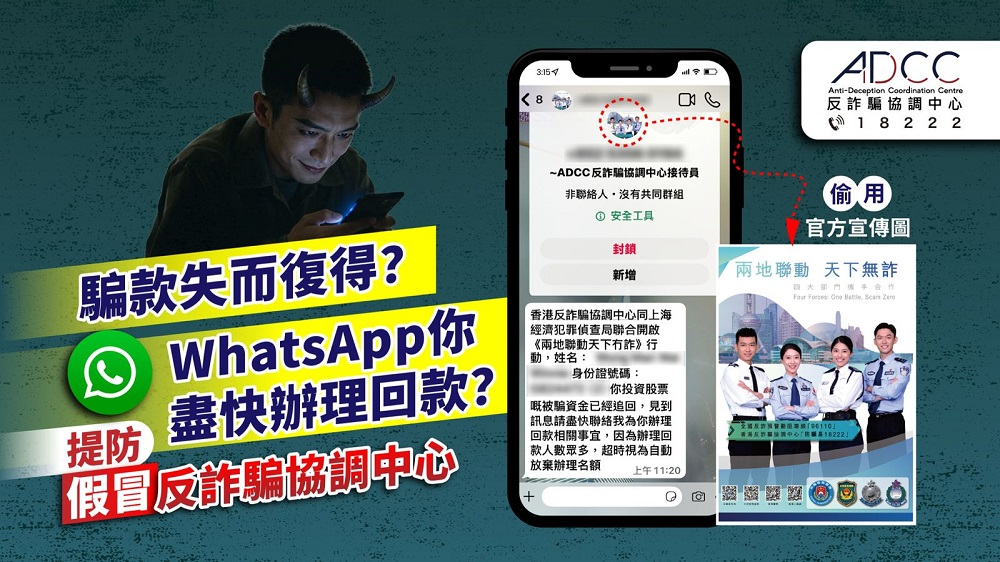
Recently, scammers posing as the Anti-Deception Coordination Centre (ADCC) used WhatsApp to proactively contact members of the public who had been scammed. Claiming that the ADCC had recovered the defrauded money, they asked victims to “make refunds” as soon as possible, otherwise the victims “would be regarded as having given up their rights”. They even stole the official slogan “One Battle, Scam Zero” to enhance their credibility.
We Emphasises That
ADCC officers will never proactively ask victims to make transfers, provide online banking passwords or any sensitive data;
ADCC officers will never use WhatsApp or any social media to “help you file complaints” or “make refunds”;
ADCC’s sole purpose of calling members of the public is issuing “scam alerts” to remind them of potential risks;
The ADCC does not have so-called “receptionist” posts.
Defaulting Trick
Using WhatsApp to send messages, scammers mention victims’ personal data, such as names and identity card numbers, straight to establish authenticity. They claim that they have recovered the defrauded money and ask the victims to contact designated “refund” channels immediately.
Once the victims make replies or calls, scammers run secondary scams, asking the victims to provide bank account, online banking login information or transfer money to designated accounts. Eventually, heavier losses are incurred.
A Real Case
A victim of an investment scam received a WhatsApp message whose sender claimed themself as an “ADCC receptionist”. Claiming that the ADCC and the Mainland police had mounted Operation “One Action, Scam Zero” and recovered the victim’s defrauded money, the sender urged them to “make a refund”, otherwise they would be regarded as having given up their right. After having a suspicion, the victim called the “Anti-Scam Helpline 18222” at once to verify the message, which was confirmed to be fake, therefore avoided a secondary scam.
Our Advice
Do not hastily believe any messages, pages or advertisements claiming to help you recover defrauded money;
The aim of phone calls made by ADCC officers is to issue “scam alerts”, i.e. to remind potential scam victims;
ADCC officers will never “assist victims in filing complaints”, “instruct victims to make transfers” or “ask victims for their online banking passwords”;
ADCC officers will only request victims to meet at police stations;
Even if strangers who send you messages are able to tell your personal information, it does not necessarily mean that they are genuine law enforcement officers. Scammers can obtain the personal information of the public by unlawful means;
If anyone claiming to be an ADCC officer contacts you and you doubt their identity, please call the “Anti-Scam Helpline 18222” for enquiries.
If in doubt, please call the “Anti-Scam Helpline 18222” for enquiries.