Beware of Fraudulent SMSs Regarding YouTube Premium Subscription Renewals and Alleged Deduction of Charges
2025-09-16
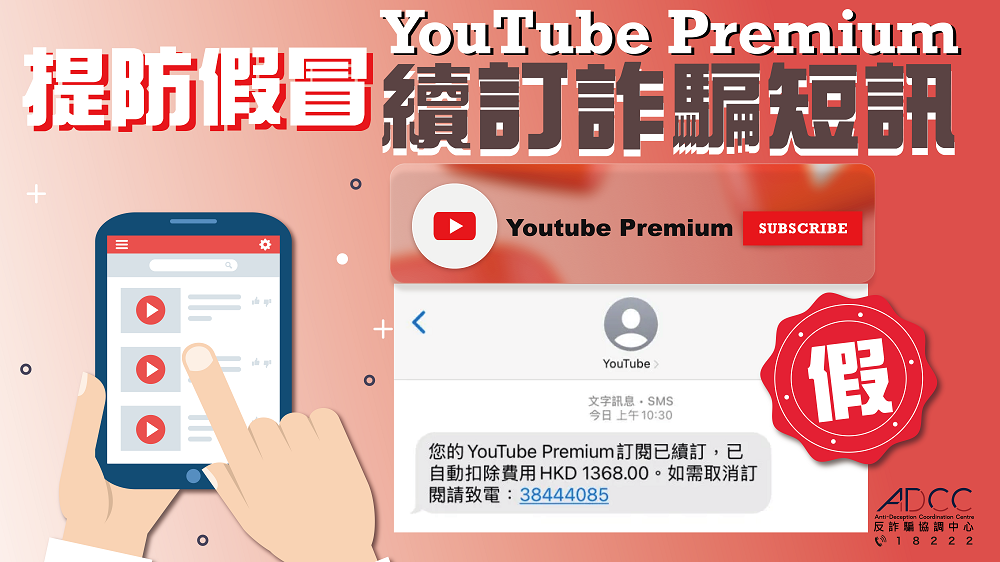
Recently, scammers have sent phishing SMSs to members of the public, claiming that charges have been automatically deducted for the renewal of YouTube Premium subscription service, along with a phone number for “cancelling the service” (as shown in the image). If you call back, a bogus customer service officer will trick you into entering your banking information on fraudulent websites or platforms in an attempt to steal your online banking usernames and passwords. [phishing SMSs / bogus customer service]
Three major flaws in the scammers’ tactics
To pressure victims into responding quickly, scammers deliberately claim in the SMSs that an amount higher than the normal subscription, such as HK$1,500, has already been deducted;
3. YouTube typically sends renewal notifications via email.
Case Example
Police have recently received multiple reports of scam cases, with victims losing between HK$100,000 and HK$210,000. In one case, a 70-year-old man who had never used YouTube Premium service received a phishing SMS mentioned above on the afternoon of 14 September. He called the number provided in the SMS. A scammer answered the phone, claiming that they could help him cancel the subscription and requesting his identity card number and bank card password. They then instructed him to download a mobile application for registration and verification. Ultimately, the scammer transferred HK$210,000 from the victim’s account.
Scammers may pose as the following organisations when sending phishing SMSs:
Binance
IBKR
uSMART
Futubull
China Mobile
SF Express
Cainiao
Keeta
Foodpanda
Our Advice
Do not rashly call phone numbers in SMSs;
Do not log on to any websites or download any attachments by hastily clicking on hyperlinks embedded in emails, SMSs or web pages;
You may enter suspicious information on “Scameter” of CyberDefender or “Scameter+”, the mobile application of “Scameter”, for security check in addition to seeking verification from relevant organisations;
If in doubt, please call the “Anti-Scam Helpline 18222” for assistance.